Understanding the 7 Laws of Money for Smart Wealth Creation
Money management and wealth creation can feel elusive, even when following conventional advice. This guide distils the seven essential laws of money that explain how money really works, based on insights from a journey spanning from janitorial work to managing billions at Goldman Sachs and building billion-dollar companies. By mastering these laws, you will understand how to compound money, control financial outcomes, and maximise returns while managing risk effectively.
Table of Contents
- Introduction to the Money Laws System
- Law 1: Money Loves Speed, Wealth Loves Time
- Law 2: He Who Gives the Money Has the Power
- Law 3: Leverage Multiplies Everything
- Law 4: Cash Flow Keeps You Alive, Equity Makes You Free
- Law 5: Risk and Reward Are Nonlinear
- Law 6: Don’t Bet the Empire for a Pot of Gold
- Law 7: Diversification Is a Hedge Against Ignorance
- Applying the Laws: Five Key Questions Before Investing
- Conclusion: Building a System to Grow Your Wealth
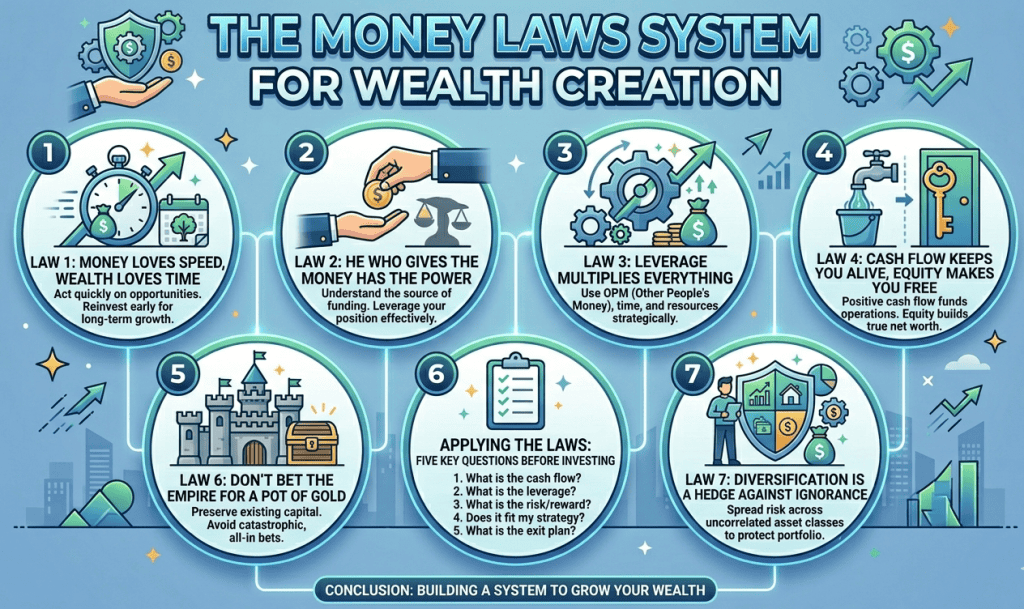
1. Introduction to the Money Laws System
Many people follow the standard rules of money—save, invest early, work hard—yet feel stuck financially. The truth is, money doesn’t follow rules; it follows laws. These laws govern how money moves, compounds, and creates wealth. The system to make more money consists of three pillars:
- Momentum: How to compound money effectively
- Structure: Who controls the money and the financial outcomes
- Asymmetry: Maximising upside while minimising downside
This framework helps transform financial thinking from random efforts to strategic wealth-building.
2. Law 1: Money Loves Speed, Wealth Loves Time
The first law reveals a critical distinction:
- Money loves speed: Act quickly on opportunities; speed is the shortest gap between seeing and acting on a chance.
- Wealth loves time: True wealth is built by holding good investments long enough to compound.
The Flipping vs. Holding Example
One investor flips properties rapidly, making quick profits by buying, rehabbing, and selling. Another buys single-family homes, then multi-unit properties, holding them for years. After five years, the holder’s net worth outpaces the flipper’s by five times because wealth compounds over time.
The Power of Compounding
Warren Buffett’s Berkshire Hathaway compounded nearly 20% annually from 1965 to 2024, outperforming the S&P 500 and generating a total return of 5 million percent. This demonstrates how compounding over time creates lasting wealth.
3. Law 2: He Who Gives the Money Has the Power
In any financial transaction, the party who provides the money controls the outcome. This law is evident in business sales and acquisitions.
Earned Income vs. Buying and Building
- No one on the Forbes 400 list made it solely through earned income (salary).
- Some made it by selling businesses.
- The vast majority made it by buying and building businesses repeatedly.
Examples include Elon Musk, Jeff Bezos, Warren Buffett, and Mark Zuckerberg, who acquire and build companies. In real estate, buyers create value and control terms—without buyers, no market exists.
The Power of Buyers
Buying companies like Instagram (Facebook) and YouTube (Google) transformed those businesses into multibillion-dollar assets. Similarly, sports franchises bought for millions have grown exponentially in value.
4. Law 3: Leverage Multiplies Everything
Leverage means using borrowed capital to increase potential returns. It is the economic engine that multiplies gains across industries.
Real Estate Leverage Example
Buying a $1 million house all cash yields a 10% return if it appreciates 10%. However, putting $200,000 down and borrowing $800,000 results in a 50% return on your investment, thanks to leverage.
Leverage in Business
Private equity uses leverage to finance acquisitions, growing companies faster than cash alone would allow. Commercial real estate uses bank financing with collateral to amplify returns and unlock tax advantages.
Billionaire Tax Strategy
Elon Musk borrowed against his Tesla stock to buy Twitter, avoiding selling shares (which would trigger taxes). This illustrates how leverage can preserve wealth while funding new investments.
5. Law 4: Cash Flow Keeps You Alive, Equity Makes You Free
- Cash flow: Money received regularly to cover expenses such as bills, mortgage, and lifestyle.
- Equity: Ownership stake that builds wealth over time.
Owning Equity
The best way to own equity is to own your own business. The second-best way is owning a share of someone else’s business, such as buying shares in publicly traded companies like Amazon or Tesla.
McDonald’s Example
McDonald’s makes significant cash flow from selling food, but its true wealth lies in franchise royalties ($1.6 billion) and real estate holdings (nearly $45 billion). This distinction highlights the power of equity ownership.
6. Law 5: Risk and Reward Are Nonlinear
Risk and reward do not increase equally; the potential upside often far outweighs the downside.
Venture Capital Portfolio Theory
A venture capital firm invests $100,000 each into five startups. Suppose:
- Two companies fail completely (loss)
- One breaks even
- One returns 10x
- One returns 100x
The outsized returns on a few investments compensate for losses, multiplying the total portfolio’s value.
Asymmetric Upside
The goal is to maximise upside while capping downside risk. This principle also applies to leverage and home buying with loans.
7. Law 6: Don’t Bet the Empire for a Pot of Gold
Investment size matters. Risking your entire savings on a single deal can lead to catastrophic loss.
The $700,000 Oil Deal Lesson
An investor put his life savings into an oil and gas deal that collapsed, wiping out 15 years of savings. The key lesson is sizing bets to protect your financial “machine”.
Managing Risk and Return
Inspired by Ray Dalio, aim to reduce risk while maintaining returns. For example, lowering risk from 150 to 60 while keeping returns near 12% is a superior strategy.
8. Law 7: Diversification Is a Hedge Against Ignorance
Diversification is not always good—it depends on your knowledge and control of the investment.
Risk vs. Control Matrix
| Understand Risk | Control Investment | Strategy |
|---|---|---|
| Yes | Yes | Concentrate (own your business) |
| Yes | No | Invest selectively (e.g. Apple shares) |
| No | Yes | Bring in operators |
| No | No | Diversify widely |
Entrepreneurs like Bill Gates and Elon Musk concentrate their wealth in businesses they deeply understand and control, rather than diversifying broadly.
9. Applying the Laws: Five Key Questions Before Investing
Before investing, ask:
- Can this compound? Is this a good long-term investment?
- Who has control? Is it you or someone else?
- What happens if it fails? Do you get any money back?
- Is the upside meaningful and larger than the downside?
- Do you understand the risks? Can you explain how it works and what could go wrong?
10. Conclusion: Building a System to Grow Your Wealth
Understanding these seven laws is the first step to mastering money. The next is applying them systematically to your investments and business decisions. By focusing on momentum, structure, and asymmetry, you can create a resilient financial system that compounds wealth, controls risk, and maximises upside.
Master these laws and build your financial empire wisely—because money follows laws, not just rules.
Further Learning
For more detailed decision systems and practical applications of these money laws (Wealth Creation), continue exploring advanced investing strategies and wealth-building frameworks.
Wealth Creation, money laws, wealth creation, investing strategies, financial leverage.

Director Digital & Social Media Marketing | Affiliate Marketing | Media Buying | Trainer / Visiting Faculty Digital Marketing. Having 14+ Years of Experience in Digital Marketing. It was my hard work and effort that I was bestowed with “India’s Top 100 Digital Marketing Leadership Award” and “Indian Achiever’s Award” 2022